Vraelis Contour overview
Vraelis Contour is model release security, from approval to reported runtime state. It is not for public use: it is built for release, platform and security engineers at suppliers and system integrators.
What Vraelis Contour is
Know what you are releasing. A model release changes how an AI system behaves, so the release itself is a security decision. Vraelis Contour is built to connect an approved model release to the runtime that receives it, and to show whether that runtime reports loading what was approved.
It keeps the evidence in order, including the observations that cannot confirm anything: an update that has not been loaded yet, or a runtime that stopped reporting.
We think the people who need this are release, platform and security engineers at suppliers and system integrators: the teams who ship model updates into systems they do not own. That is a hypothesis we are testing, not a customer base.
Status
What exists today is a controlled synthetic ONNX CPU experiment and a read-only evidence app over the trace it recorded. Nothing in these docs describes a deployment, a customer or an available service.
- Working in the experimentSigned release and approval bindings, runtime policy enforcement for ONNX Runtime 1.23.2 with exactly CPUExecutionProvider, real CPU inference, and desired against reported loaded observations in baseline and reconcile modes.
- Working in the experimentA read-only evidence app over the recorded trace.
- MeasuredAt the runtime rejection-diagnostics revision, 133 of 133 internal experiment tests passed in the pinned, network-disabled harness. Internal automated testing reproduced that suite on a separate build on October 10, 2026 (Pacific), and the retained test log was checked against its SHA-256. This is automated reference-experiment evidence, not a formal product milestone, independent human review, production validation or customer demand. The earlier runtime-policy revision passed 131 of 131; 133 supersedes that count and is not 133 additional tests.
- MeasuredA runtime-version mismatch was checked by a separate internal automated test with a real ONNX Runtime 1.22.1 worker. Receipt integrity is covered by signature tests in the suite, not by external signature verification.
- ProposedA Kubernetes collector, in specification v1.3. The proposal has not been applied.
- Not built yetHeartbeat freshness, live fault runs, a latency study and adapters for customer runtimes.
- Not claimedHardware attestation. Worker reports are self-reports, not independent attestation.
The five-step workflow
Vraelis Contour is organised around five steps. Each step says what exists in the experiment and what is still proposed.
- 01Identify the release
- 02Bind approval to the release and destination
- 03Integrate with a supported runtime
- 04Compare approved and reported
- 05Preserve discrepancies, missing evidence and recovery
- Identify the model artifact, preprocessing and configuration. A release is named by digest, so it is one exact thing. In the experiment: model and configuration digests. Proposed: preprocessing identity. Release identity
- Bind approval to the exact release and destination. An approval names the release and where it may run, under a runtime policy with an age limit. In the experiment: signed bindings. Approval binding
- Integrate with a supported receiving runtime. The runtime checks the policy before it serves. In the experiment: ONNX Runtime 1.23.2 on CPU. Proposed: adapters for customer runtimes. Runtime integration and policy
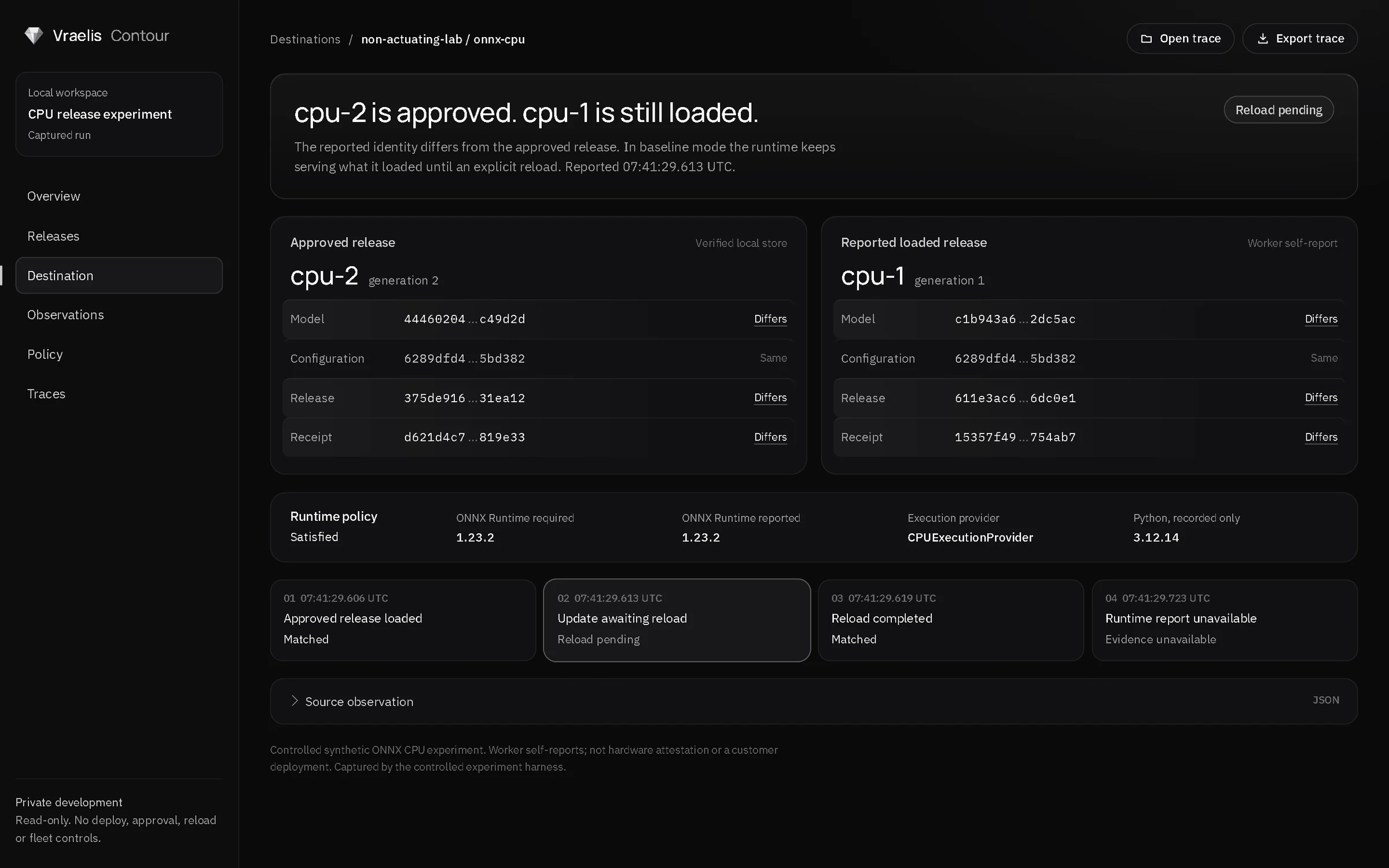
- Compare the approved release with its reported loaded identity, field by field. In the experiment: the evidence app shows both side by side. Comparing approved and reported
- Preserve discrepancies, unavailable evidence and recovery records. Every observation is kept, including the ones that confirm nothing, and the explicit reload that followed. In the experiment: recorded observations. Proposed: an investigation workflow. Evidence and observations
Where Vraelis Contour sits in Vraelis
Vraelis develops cybersecurity software for AI in defense, critical infrastructure and autonomous systems. Our work spans model integrity, adversarial threats, machine trust and security evidence. Those four are research areas, not products. Vraelis Contour is the first product, and today the only one. Products
Defense, critical infrastructure and autonomous systems are intended application areas. Vraelis has no deployments in them.
Every claim in these docs is labelled as working in the experiment, measured, proposed, hypothesis or not claimed. How to read these docs
Product pictures are captures of the read-only evidence app reading the recorded trace. They are not mockups and they do not show a customer deployment.
Last updated: October 10, 2026